Posted on: April 15, 2026 By: hcarter@consolidated.coop
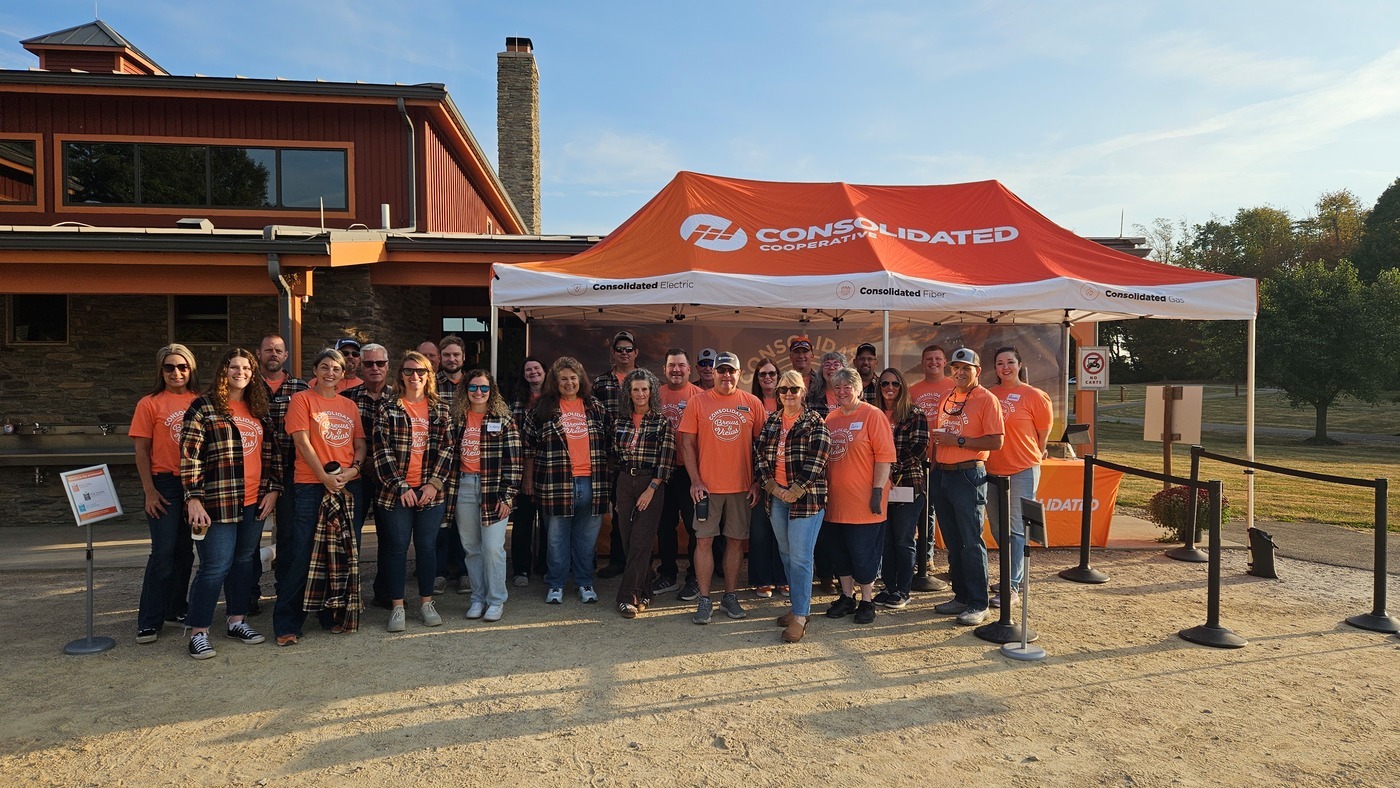
Back by popular demand – we are excited to host three Brews & Views events in 2026!
We created Brews & Views to provide a more casual, conversational space where Consolidated members can engage in-person with our team and trustees. Join us to enjoy live music, great food trucks, and a free drink while our team is available to answer all your questions!
Whether you want to learn more about our co-op, get the inside scoop on the energy world, or ask specific questions about our programs and services, we will have experts ready for you at Brews & Views.
Each membership can reserve up to two spots for a Brews & Views event – including $15 in food vouchers and a drink ticket for each spot, plus one gift ticket. Space fills quickly, so pay close attention as each event approaches!
Flying Horse Farms – RSVPs Full
RSVPs are now full for Brews & Views on May 16. We are so thankful to see your excitement for this event! If we missed you this time, please plan to join us for one of our other 2026 Brews & Views events!
We look forward to gathering at Flying Horse Farms for breakfast and coffee on Saturday, May 16 from 9-11 a.m.! Flying Horse Farms is a beautiful camp right across from our office in Mount Gilead, you can learn more about them in our Key Account Spotlight!
Food Truck Lineup
We’re changing up our food voucher system for this event. Each food truck will offer a small menu of $5-10 items, and each registered guest will get three $5 vouchers to use at their discretion. This will help the food trucks put out their delicious food quickly, and it will give you the chance to try all of the trucks if you would like to!
The Columbus Coffee Truck – A wide menu of coffee, tea, and other specialty beverages. Each registered guest will get a drink ticket to use here.
ChillJoy – Three flavors of smoothie bowls; you choose your toppings.
Belgica Confections – Belgian waffles with a variety of toppings.
Roadster – Savory breakfast sandwiches and tater tots.
Live music will be provided by Brian Douglas Day.
How do RSVPs work?
RSVPs fill very quickly, so make sure you know how to reserve your spot!
About two weeks before each event (exact dates listed in the Event Schedule), we will open up RSVPs through an online form. Typically, RSVPs open at 3 p.m. – we will put out a reminder on our social media pages the day before.
When RSVPs open, we will send the link out directly to all members subscribed to our email, we will publish it on our social media pages, and we will add the link to this page.
When RSVPs are full, we will send out more a confirmation via email to everyone who RSVP’d. Generally, we send this 1-2 days after RSVPs fill, because we have to go through a verification process first.
For our second and third events of the year, we will prioritize RSVPs from members who have not attended another 2026 Brews & Views event. We do this to help as many members attend as possible.
2026 Event Schedule
Saturday, May 16: Flying Horse Farms in Mount Gilead, 9-11 a.m. – RSVPs Open April 28
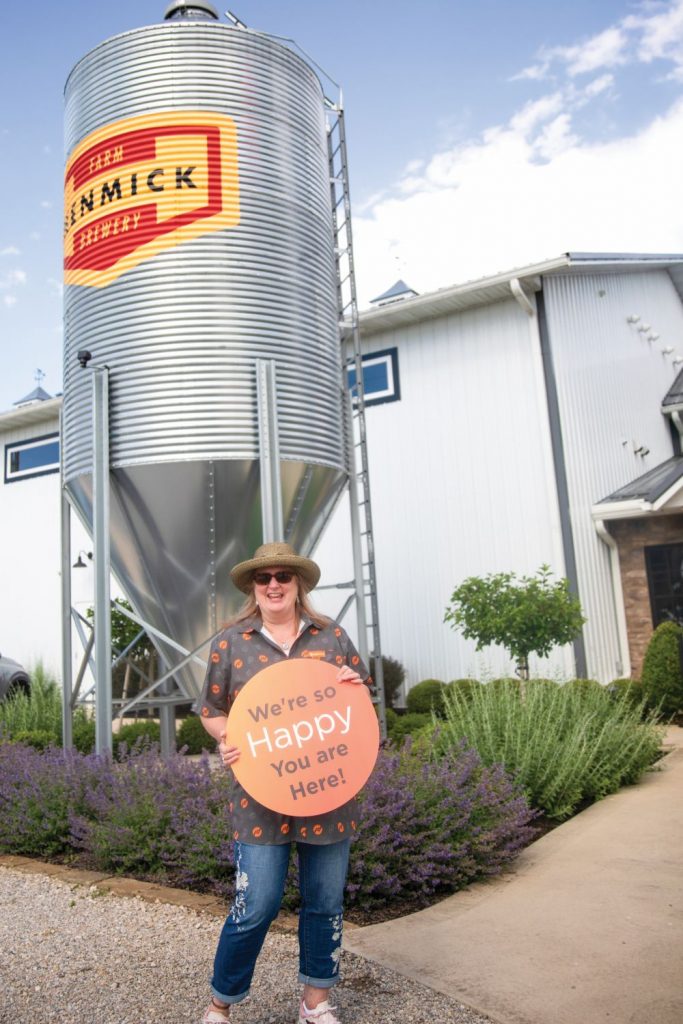
Tuesday, August 4: Henmick Farm & Brewery in Delaware, 5-8 p.m. – RSVPs Open July 21
Tuesday, October 13: Hoof Hearted Brewing in Marengo, 6-8 p.m. – RSVPs open September 29
Posted on: April 10, 2026 By: hcarter@consolidated.coop
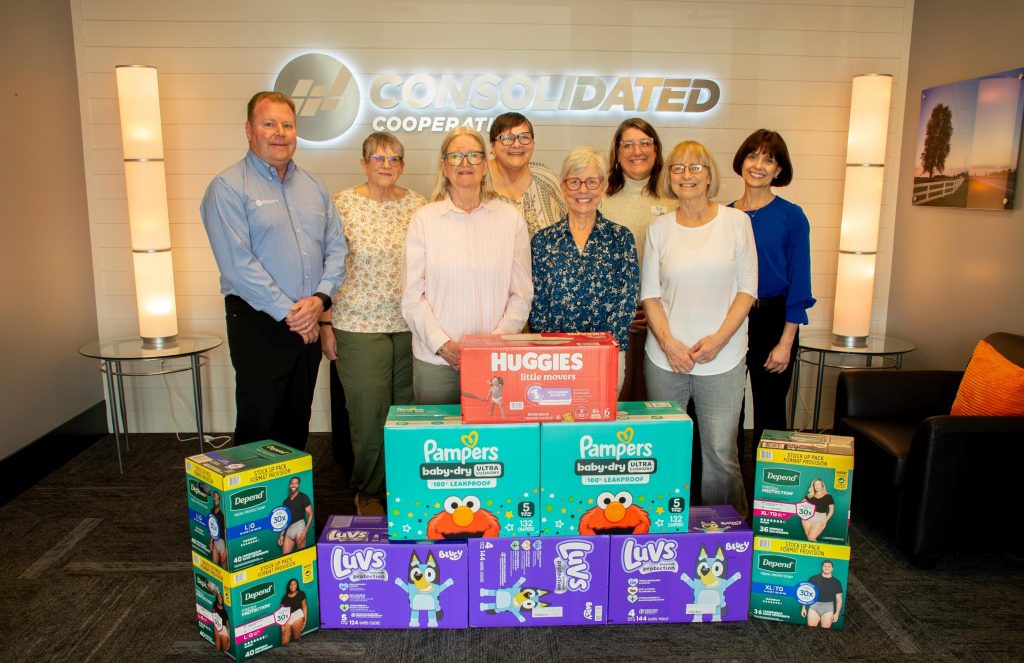
This spring, we partnered with the CoBank Sharing Success Program to provide a total of $30,000 to two local organizations that provide diapers for individuals and families who are in need.
The following organizations each received $15,000: United Way of Delaware County and Morrow County Community Action. The money will be used specifically to purchase diapers for people of all ages, from infants to adults.
Why diapers?
Last year, we partnered with CoBank to donate funds to local food banks. This year, we were looking to continue meeting practical needs within our communities, and we discovered a growing need for diapers.
From July 1, 2024, to June 30, 2025, the Delaware County Diaper Bank alone dispersed 74,455 diapers to families in need, which was a 34% increase from the previous fiscal year.
We asked representatives from each organization that received a grant to tell us a little more about why it is important for them to provide diapers:
“Even after working a couple of jobs, many parents are faced with stress, guilt, and anxiety of not being able to provide a healthy supply of diapers,” shared Brande Urban, Associate Vice President of Programming & Initiatives at United Way of Delaware County. “Public safety net programs, such as WIC and SNAP (previously known as Food Stamps) do not cover the purchase of diapers, leaving many families with the difficult choice of buying diapers or other necessities with their limited resources & funds,”
“Providing diapers promotes socialization, particularly for seniors and individuals with disabilities, by enabling them to participate more comfortably in daily life and community activities,” stated Cindy Wallis, Director of Morrow County Community Action for OHCAC. “In addition, access to these essential items allows many individuals to maintain employment and attend important social functions.”
Both organizations will distribute diapers through multiple locations in Delaware and Morrow County, including local nonprofit organizations like food pantries, family resource centers, and more.
“Thanks to Consolidated and the CoBank Sharing Success grant, we will be partnering with several local agencies to effectively serve our community and distribute these products where they are needed most,” shared Wallis.
Get Connected
If you or someone you know needs assistance, please see the information below to get connected with these impactful organizations.
Ohio Heartland Community Action Commission:
One of the easiest ways to access OHCAC’s services is by visiting their office at 28 W. High St., Mt. Gilead, Ohio 43338, or by calling them at 419-946-2009.
Individuals can also connect with OHCAC through their many community partners, including Morrow County Head Start, the Morrow County Veterans Association, Goodwill, OhioHealth, Morrow Family Health Center, Cornerstone of Hope, Helpline (211), Dollar General, Flying Horse Farms, United Way, Seniors on Center, Job and Family Services (JFS), and the Area Agency on Aging (Morrow County), as well as numerous local churches.
United Way of Delaware County:
You can get referred to Diaper Bank locations through the over 50 UWDC Strengthening Families Partner Agencies, found here.
Individuals may also make monthly visits to the locations listed here. Each site has their own policies regarding how diapers are dispersed, and individuals can contact them directly with any questions.
Morrow County Community Action (Left): Brad Ebersole, Cynthia Wallis, Joe Devaney, Wendy Robichaud.
United Way of Delaware County (Right): (Back Row) Brad Ebersole, Jeanne Casanova, Connie Grossman, Brande Urban, Wendy Robichaud; (Front Row) Diane Huston, Vicki Lefevre, and Margo Bartlett.
Posted on: March 14, 2026 By: hcarter@consolidated.coop
The extreme winds on Friday, March 13 did extensive damage to our system and knocked out transmission to three of our substations.
Our crews were out working all day Friday as the winds continued and outage numbers were on the rise. By the time conditions improved, we had over 10,000 members out of power.
Due to the severity and widespread nature of the damage, we anticipate a multi-day restoration effort, and we are working to secure additional crews to help us recover safely and efficiently.
Please follow us on Facebook for updates as our restoration efforts progress. We are also publishing the updates at the bottom of this page, but Facebook will be the most timely source.
Check out this article from Ohio’s Electric Cooperatives to see how the storm impacted co-ops across Ohio.
Important Safety Reminders:
These reminders are specific to common reports from this storm. Please view our Storm and Outage Safety Page for more safety information.
Generators: Backfeed and Lineworker Safety
Prevent Backfeed – keep our crews safe!
Improper generator setup can be fatal for utility workers and tree crews trying to restore your service.
Backfeed occurs when electricity flows from your home back onto utility lines. This can energize “dead” lines and put workers at risk of electrocution.
Never plug a portable generator directly into a wall outlet. Use a professionally installed transfer switch or plug appliances directly into the outlets on the generator itself.
Partial Power
What is “Partial Power”?
Most homes run on a 120/240-volt system delivered via two “hot” wires and one neutral wire.
If one “hot” wire is damaged (by a fallen limb or a tripped transformer fuse), you lose roughly half of your 120V circuits.
Large appliances (HVAC, water heaters, ovens) require both wires to provide 240V. If one is out, these appliances will fail to start or, worse, try to “backfeed” power through other circuits, which can cause damage.
Immediate Safety Steps
Report the Issue: Even if you have some power, it is important that you report the partial outage right away.
Turn off large 240V appliances: Switch off your HVAC system, electric water heater, and clothes dryer at the breaker box. Operating these with only partial power can burn out their motors or compressors.
Unplug sensitive electronics: Computers, TVs, and smart appliances can be damaged by the voltage fluctuations associated with a partial outage.
Check your main breaker: Flip your main house breaker all the way to “OFF” and then back to “ON” once. If the issue persists, the problem needs further investigation.
Downed Powerlines
Steer clear!
Always assume that any downed wire is energized and dangerous.
Stay at least 35 feet away (about the length of a school bus).
Never try to move a line or remove debris from a line yourself – it takes significant training and special equipment to do so safely.
If a wire falls on your vehicle while you are inside, stay put and call 911. If it is too dangerous to stay in the vehicle due to a fire or other hazard, secure any loose articles of clothing and jump clear, ensuring that you do not touch the car and the ground at the same time. Then, hop or shuffle away as far as you are able, making sure both feet are touching the ground at the same time.
Outage Tracking and Reporting
Use our Outage Map to track outages and restoration progress.
You can report outages or online through your Consolidated SmartHub account, or by calling our 24-hour outage hotline: 866-567-2753 (please call using the phone number linked to your account – our computer system will automatically register your outage). Learn more about outage reporting.
Outage Updates
Outage Update: 3/16 – 9:30 a.m.
The feeder outage impacting the Olive Green area has been restored. Our crews are continuing to repair damage from Friday to restore the remaining outages.
Outage Update: 3/16 – 6:45 a.m. – New Outages
This morning, we lost a feeder that serves in and around the Olive Green Area. We have a team member on their way to assess the situation, and we will update this post with more information when we have it.
Crews are ready for another day of hard work repairing damage and continuing to restore power for our members who have been out since Friday. We know this has been a long time without power for some of you, and extended outages cause a lot of stress.
Thank you for hanging in there with us as we do everything we can to restore your power safely and efficiently. We will provide more updates throughout the day.
Outage Update: 3/15 – 9:45 p.m. – Final Update of the Day
We are down to 268 members out of power with 88 unique outages. One of our mutual aid crews from Indiana had to head home today due to wind damage in their territory, but we are expecting a couple more to join us tomorrow.
There is still a lot of damage to repair, and we are hoping that tonight’s wind does not add damage to our system. We will continue updating you tomorrow as we progress, and as we have a firmer idea of when work will be complete.
Thank you for all of the kind words you have sent our way throughout these challenging circumstances – your support and understanding mean so much to our team. We understand that this is an incredibly difficult situation for our members who have been without power since Friday, and our teams have been doing everything we can to repair damage and restore power safely and efficiently.
Outage Update: 3/15 – 6:20 p.m.
We temporarily bumped back up to about 2,100 members out of power due to some voltage issues. We had to shut off three feeders to ensure the safe delivery of power, but we are in the process of getting things switched back and restored. Full restoration for these outages may take up to 1-2 hours.
UPDATE: All three feeders have been restored.
Our crews have not stopped working to repair damage causing the outages from Friday’s winds.
If you have damage to report, please do so using our 24/7 number – 800-421-5863, option 0. If you believe the damage is a danger yourself or others, please report it to 911 first. We cannot process damage reports or account information over Facebook; please use our approved outage and damage reporting methods to ensure that your report is properly registered in our system.
Outage Update: 3/15 – 3:30 p.m.
Our teams’ hard work has brought us down from about 2,500 members out this morning to about 595 members out now. We cannot provide estimates for individual areas at this time, but we can say that restoration will definitely continue through tomorrow.
Here are some of the factors currently impacting our restoration timeline:
– Though our total number of members out has decreased significantly, the number of unique outages is still quite high at 142 due to the widespread damage. This means that each outage we restore will bring power back for a small number members. You can see this demonstrated if you zoom in on our outage map: https://outagewatch.consolidated.coop/
– Though each outage impacts fewer members, many still involve severe damage that takes time to restore safely.
– Our area is under a wind advisory again through tomorrow morning, which could lead to more damage.
Thank you for staying with us, we know this is a very difficult, stressful situation and we are doing everything we can to restore power safely and efficiently. We will continue to update you here as we progress.
Outage Update: 3/15 – 7:30 a.m.
Our crews got back to work early this morning, and they are continuing to progress through repairs. We will update you here when we have more information to provide, but we do still anticipate that some restoration efforts will continue into Monday.
When we are recovering from extreme damage like this, progress can seem to slow down over time, but please rest assured that our crews are continuing to work just as hard as they have been. We typically start with outages that are impacting the most members, so power comes back on in larger sections. As we progress, though individual outages still have similar amounts of damage to repair, each one impacts fewer members.
If you have questions about your fiber service, please contact our support team at 800-421-5863 (option 4). They will be able to provide more information about restoration in your area.
Outage Update: 3/14, 10:00 p.m. – Final Update of the Day
We are down to about 2,500 members out, and some members will come back on yet this evening. Transmission has now been restored to all substations, but we still have a lot of repair and restoration work ahead of us.
Our crews have to head in for the night, but they will be back at it at 6 a.m. We do not have estimated restoration times for specific areas at this time, but we do anticipate that some restoration efforts will stretch into Monday, especially as weather reports are calling for more high winds tomorrow. We will provide more information as work continues tomorrow.
We understand that extended outages can cause significant stress, and we will continue doing everything we can to restore your power safely and efficiently. Thank you for your continued patience and understanding.
Outage Update: 3/14, 6:20 p.m.
We currently have about 153 outages and 3,000 members out.
We are still dealing with a transmission outage in Marengo, but we have crews working to restore a feeder in the area that will allow us to reroute power to more members.
Outages will continue into tomorrow, but we are working hard and hope to have a better idea of how long it will take to reach full restoration later tonight. We know that extended outages are very stressful, and we are doing everything we can to restore your power safely and efficiently.
For fiber service, some damage occured in the northern portion of our territory that cannot be repaired until electric is finished. If you have questions, please call 800-421-5863 and press option 4 to speak with our fiber support team.
We have heard from some members who are receiving notice that their power is restored when it is still out. If this happens to you, it typically means that we restored a larger outage in the area, but your home was impacted by a different, smaller outage. If you do not see your home reflected on our outage map, please report it again to ensure the outage is in our system.
Outage Update: 3/14, 3:15 p.m.
Our crews have been working tirelessly today, and electric outages are now down to about 3,300 members. We still have a lot of work to do, but we are making progress.
There is still so much damage to address that we are not able to offer accurate estimates for full restoration, but we will provide updates whenever we have information to share. We understand that this is a very difficult, stressful situation and we are doing everything we can to get your power back on safely and efficiently.
Outage Update: 3/14, 10 a.m.
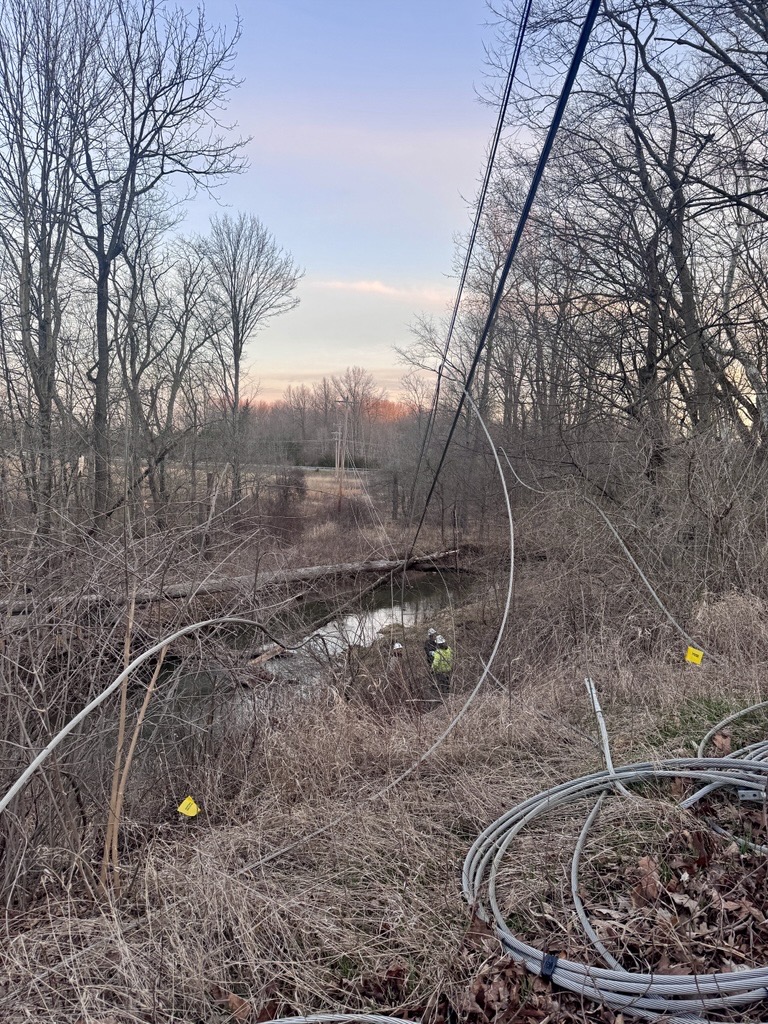
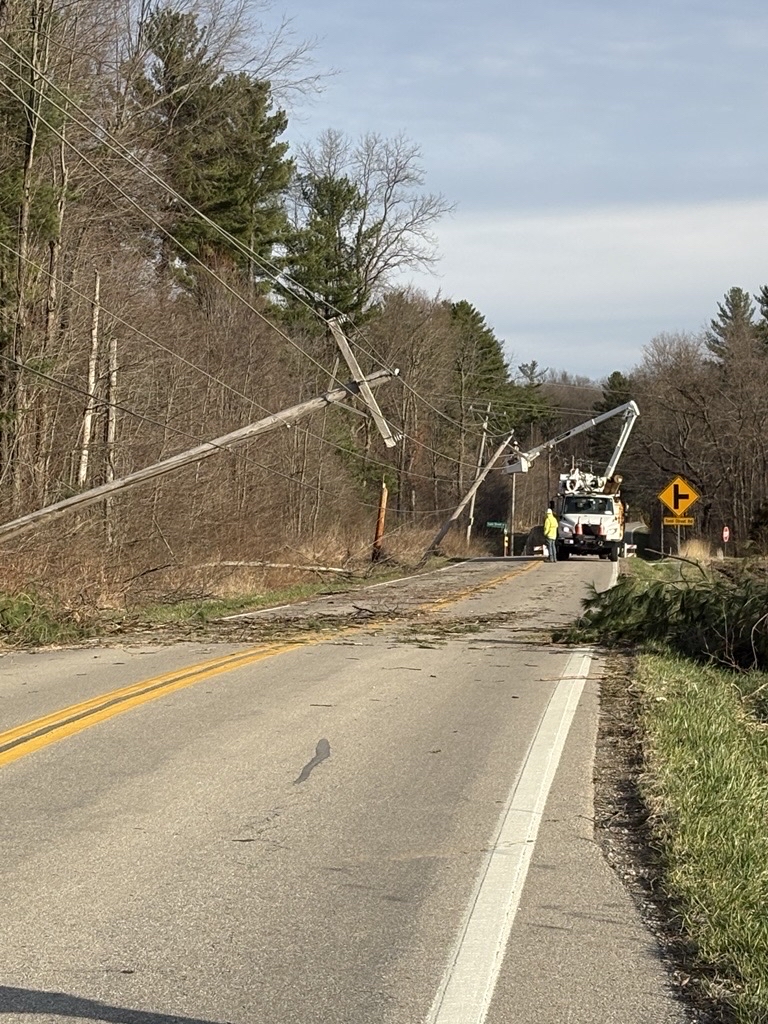
Electric outages have gone down from over 8,800 members when crews set out this morning to about 6,300 members now. We still have transmission outages to two of our substations, and a lot more damage like what you see in the pictures below, but our crews are working hard to repair and restore power safely and efficiently.
We have received one assisting crew from Mid-Ohio Co-op already, and we have two more crews heading our way from Indiana. Due to the extent of the damage, we do not have restoration estimates at this time, but we will provide more information when we can.
Please remember to steer clear of downed power lines, and NEVER try to remove debris yourself.
Outage Update: 3/14, 6:50 a.m.
Crews loaded up and headed out around 6:30 this morning. We have two additional crews heading our way, and we are awaiting word on more to help us continue repairs and restoration. We will provide more updates as we progress today.
Important Reminder: If you see a downed powerline, stay away! Even if the line seems de-energized, they can become re-energized as we restore power. Never approach a downed powerline, and never try to clear debris from a line yourself.
Outage Update: 3/13, 10 p.m.
After a long day of challenging, hazardous work, our crews have to head in tonight for their safety. We will resume restoration work in the morning.
Thank you for your patience through this difficult situation. Please stay safe, look out for your neighbors, and keep our crews in your thoughts. We will update again when we have more information tomorrow morning.
Outage Update: 3/13, 8 p.m.
Electric and fiber crews are out working hard to assess damage, make repairs, and restore service.
The winds did extensive damage to our system today that will take time to fully repair and restore, and we currently have transmission outages at three of our substations.
We have requested assistance from additional crews, but outages will be extended for many of our members.
We do not have restoration estimates at this time, but we will update you here when we do.
Thank you for your patience and understanding. We are doing everything we can to get your service back on safely and efficiently.
Posted on: March 10, 2026 By: hcarter@consolidated.coop
Our teams are prepared for spring storms – make sure you are too! Please read through the information below to help keep you and your family safe if outages occur.
Call our 24-hour outage hotline: 866-567-2753 (please call using the phone number linked to your account – our computer system will automatically register your outage)
Sign up for Outage Alerts to receive text message updates about outages in your area.
Use our Outage Map to see the impact of an outage across our territory and track our restoration progress.
Outage Preparation
Do you have any medical equipment or treatments that require electricity or refrigeration? Make a plan with your doctor or pharmacist to ensure that you know how to stay safe when a power outage occurs.
Maintain an emergency kit with necessary items like non-perishable food, water, flashlights, batteries, a first-aid kit, etc.
Make sure you have blankets and warm clothing easily accessible.
Take time to charge important devices like phones, laptops, and portable batteries before the bad weather hits.
Ensure that all of your sensitive electronics are protected from power surges. Remember that newer appliances often include computer elements and will need surge protection. Read this article to learn more about the importance of surge protectors and how to pick the surge protectors that best suit your needs.
Remember to include your pets in your preparations!
Outage Safety
Never approach a downed powerline, even if it appears to be de-energized. Lines can become re-energized as restoration efforts progress. If you see a downed line, call us and 911 right away.
Do not try to remove any debris from a powerline, even if you think it may be impacting your service. Without the proper training, equipment, and safety gear, it is extremely dangerous to go near a powerline.
During the restoration process, sometimes power comes back on in spikes that can damage electronics. Unplug all electronics and heat-producing appliances when an outage occurs.
Generator Safety
Read your manual for important safety information that is unique to your generator.
Before starting your generator, make sure your home is equipped with battery-backup carbon monoxide detectors, and test them to ensure they are working properly.
Never operate your generator inside your home, garage, barn, porch, or any other enclosed or partially enclosed space. Keep it at least 25 feet away and make sure the exhaust is directed away from windows, doors, and vents.
Never plug your generator into a wall outlet to try and power your home – this can send electricity down de-energized lines, putting line workers in serious danger.
Posted on: March 5, 2026 By: hcarter@consolidated.coop
In 2024, we partnered with Morrow County to expand our natural gas service supporting the I71/SR61 interchange. We finished construction and testing at the end of 2025, and the pipeline is now complete.
Consolidated brought natural gas to the I71/SR61 interchange decades ago, but demand from recent growth in the area pushed our existing pipeline to the limits of what it could deliver. This location needed significant additional capacity to continue supporting projects that will enhance quality of life and bring jobs to the area.
“As we continue to keep our targeted areas of growth in mind, I am encouraged to work with companies, like Consolidated Cooperative and to be able to think outside the box on how we can meet the current and future needs of our community,” said Jamie Brucker, Morrow County Director of Operations.
As a not-for-profit cooperative, we had not expanded because we did not want our current members to bear the risk of the investment. Morrow County stepped up as a partner because the anticipated business growth stands to create numerous economic benefits for the entire county and surrounding areas.
Expanding our natural gas service in this area will allow new businesses and organizations to build in our communities, bringing in jobs and enhancing the local economy. Through our partnership, we will be able to pay back the cost of the pipeline as funds come in from the members the pipeline will serve. In addition, these new members will also increase the amount of natural gas we purchase, helping us get better bulk rates over time.
“As Morrow County’s local, not-for-profit cooperative, we are proud of our nearly 90-year commitment to working alongside so many others who continue to strive to make our communities places where we can all prosper.” Shared Consolidated President and CEO, Phil Caskey. “This project is yet another shining example of the great work we all can do when we work together.”
We are confident that Consolidated members and Morrow County will see a significant return on this investment over time – both through financial income and through community and economic enrichment. We have already had multiple businesses express interest in building in the area, and we are excited to have the capacity to meet the needs of new projects.
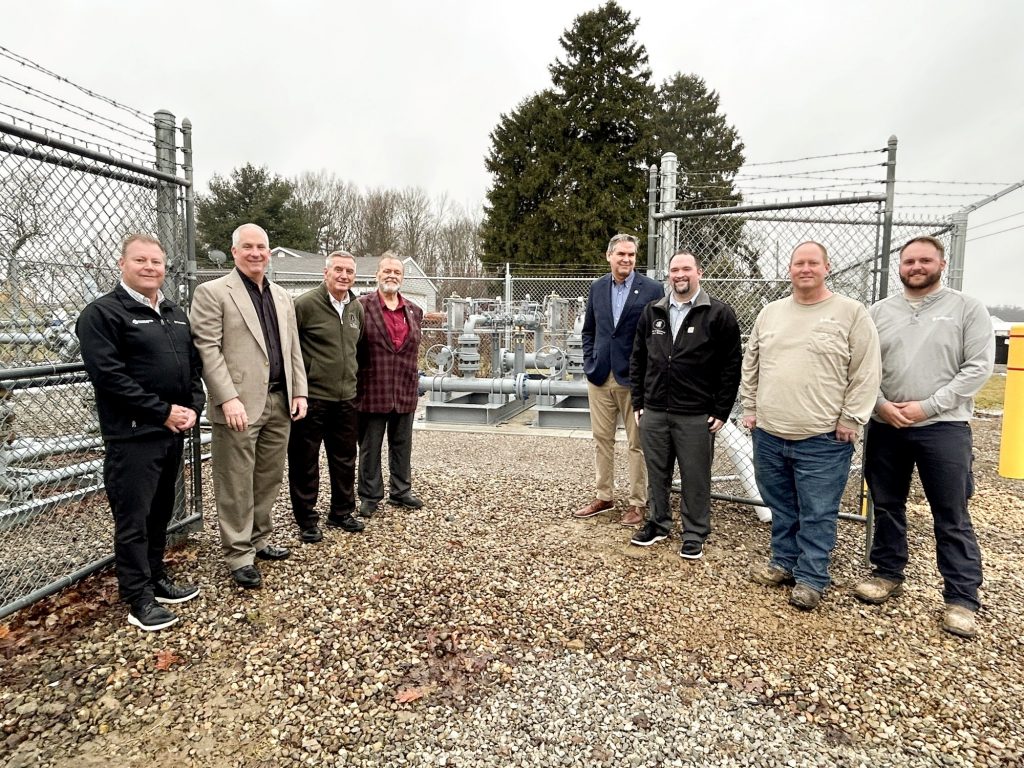
Pictured, left to right:
Brad Ebersole, Consolidated Community and Government Relations Director; Phil Caskey, Consolidated President/CEO; Morrow County Commissioners: Tim Abraham, Tim Siegfried, and Jon Mason; Jamie L. Brucker, Morrow County Director of Operations; Jack Cramer, Consolidated Gas Operations Manager (former); Chance Stepp, Consolidated Gas Operations Manager (current).
Posted on: February 1, 2026 By: hcarter@consolidated.coop
Reliability and Affordability Concerns
For 90 years, our mission has been to deliver safe, reliable, and environmentally responsible electricity to our members at stable and affordable rates. Our members count on us to deliver their power 24 hours a day, 7 days a week, 365 days a year – our communities and livelihoods depend on it. But, for the first time in our history, that reliability is in jeopardy.
Buckeye Power, our generation and transmission provider, generates enough power for all 400,000 cooperative members in Ohio. However, we depend on the larger grid to get that power to our members, and the grid’s ability to balance supply and demand in our region and across the nation is increasingly at risk. Shortages in one area can cause shortages and blackouts at other places on the grid.
January, 2026 Reliability Assessment
The North American Electric Reliability Corporation (NERC) released a concerning Long-Term Reliability Assessment in January, 2026. Based on their research, many regions across the U.S. are at an elevated risk for energy shortfalls over the next five years.
For PJM, the grid operator for Ohio and 12 surrounding states, NERC reports that current projections for energy resource additions do not keep the pace with the forecasts for increasing demand and retired generation. Basically, they anticipate that unless things change, demand will begin to exceed supply across the grid – during extreme or even normal weather conditions.
Here are a few of the reasons why the risks to reliable, affordable energy are growing:
Demand for electricity is higher than it has ever been, and it continues to rise, especially as more data centers are popping up.
The overall supply of reliable electricity is down because of the rapid retirement of coal and nuclear plants.
Intermittent sources of energy like wind and solar power have come online, but they have not filled the gap and they are not always available.
Unreasonable regulations are creating unnecessarily high costs while providing minimal environmental benefits, leading generation sources to shut down and preventing investment in new sources.
What can we do about it?
Energy Conservation
During times of extreme demand (like during a cold snap), you may hear about “peak alerts” or “peak demand.” A “peak alert” occurs when a utility provider is close to demanding more electric power than they have ever used before. When demand reaches a new peak, it also sets a new, higher price that we have to pay for electricity.
Now more than ever, it is important for us all to try and safely conserve power during times when demand is high – not just to avoid rising costs, but also to help avoid the need for rolling blackouts. Conservation during peak times can be as simple as lowering your thermostat by a few degrees, or turning off unused appliances and electronics. Learn more about peak alerts here.
Political Action
Consolidated leaders attend events in Washington, D.C. and at our Ohio statehouse to meet with policy makers and speak up for the good of our members. You can join us in advocating for common-sense energy policy. Check out America’s Electric Cooperatives PAC and Voices for Cooperative Power to learn more about how you can get involved and speak up for cooperative members!
America’s Electric Cooperatives PAC
The National Rural Electric Cooperatives Association (NRECA) has renamed its political action committee: The program once known as “ACRE” is now America’s Electric Cooperatives PAC.
This political action committee (PAC) was founded in 1966 to support political candidates who speak up for and protect the interests of electric co-ops and their member-owners. Thousands of co-op members, employees, and directors from across our nation contribute to the PAC.
PAC accepts contributions on a monthly basis, and the average contributor gives about $65 per year. When everyone’s individual PAC contribution comes together, it builds our collective strength as cooperatives across the nation. This strength and recognition on the national level is key as decarbonization and electrification policies have threatened cooperatives’ ability to deliver power to their members.
If you would like to be a part of this national movement, click here to make a donation, or give us a call at 800-421-5863 for help.
Voices for Cooperative Power
Join us in speaking up for reliable, affordable electricity! Voices for Cooperative Power (VCP) is a network of rural electric cooperative members who work together to promote policies that help cooperatives thrive. VCP makes it easy to be an advocate by empowering you to share your story, connecting you with opportunities to use your voice, and keeping you informed about important issues and policies.
You can choose your level of involvement – whether you use the information they provide to be an informed voter, or you take advantage of opportunities to contact legislators and speak up for cooperatives. Learn more about VCP at voicesforcooperativepower.com or get in touch with us at Consolidated for help.
Resources
“Reliability and Affordability” – This webpage from America’s Electric Cooperatives (NRECA) will give you a background of the current energy landscape, the cooperative stance, and a timeline of the events that led up to this point.
“EPA Power Sector Rules” – This article from America’s Electric Cooperatives gives an overview of key regulations that threaten reliable, affordable power, and it provides updates as decisions progress.
Here is a short list of some of the key terms and organizations that you will read about while researching this topic. Click or tap the link in each point to learn more or visit the organization’s website.
The Electric Grid: The complex, interconnected system that transports electricity from power plants through substations, transformers, transmission lines, and the distribution lines that deliver energy to consumers. Learn more about the electric grid.
PJM: PJM Interconnection – a regional transmission organization that ensures reliability and coordinates the movement of electricity in Ohio and 12 surrounding states.
NRECA:America’s Electric Cooperatives – the national organization designed to promote, support, and protect the best interests of electric cooperatives and their members.
OEC:Ohio’s Electric Cooperatives – the statewide organization designed to promote, support, and protect the best interests of electric cooperatives and their members in Ohio.
EPA: The United States Environmental Protection Agency – The EPA was founded to study environmental issues, provide information, and develop and enforce environmental standards and regulations in America.
Posted on: January 26, 2026 By: hcarter@consolidated.coop
Due to cold weather and high demand, our natural gas supplier has issued “Transport Critical Days,” which will likely continue through the end of January. This means that all natural gas purchased during this time will cost significantly more than usual.
While Transport Critical Days are widespread and we cannot change them, we can help mitigate their impact by conserving gas while costs are high. If you are able, please join us in reducing natural gas use until Transport Critical Days are over.
Read through the FAQ below to learn more about Transport Critical Days and their impact.
What are “Transport Critical Days”?
Natural gas suppliers issue Transport Critical Days when demand is at extreme highs, typically in January or February. This happens when end-users are consuming natural gas at a rate that is not sustainable for the pipelines and/or stores that supply the fuel throughout a region. Natural gas becomes significantly more expensive during these times, because it may come from other sources or dip into reserves.
How will this impact me?
As a not-for-profit cooperative, our rates reflect the costs we pay for the services we provide you. This means that we never charge extra to make more profit, but it also means that when our costs increase, our members’ costs increase too.
Due to our supplier’s timing, these increased Transport Critical Day costs will likely be reflected on the bill you receive in March. The line item will be titled: “Critical Peak Charge.” We will not know the financial impact on our members until we receive our bill from our supplier, which will be after our February billing cycles have already begun.
We will divide the additional charges based on use, so that no members pay more than their fair share. We will publish more information and billing date confirmation after we receive our bill.
Why do members have to pay these added costs?
As a not-for-profit cooperative, our rates reflect the costs we pay for the services we provide. This means that we never charge extra to make profits, but it also means that when our costs increase it increases our members’ costs too. We call these “pass-through” costs, because they do not originate with Consolidated and we do not add onto them; we pass them through from suppliers.
Is this normal?
Transport Critical Days occur almost every year with varied impact. The extended cold and extreme weather will likely lead them to have a more noticeable impact this year.
What can Consolidated and its members do about this?
The best way to mitigate their impact is to use less natural gas while they are in effect, so we purchase less gas at the elevated rates.
There are two options that can help some natural gas providers lower the risk of supply challenges and Transport Critical Days; we have explored both thoroughly throughout the years of our natural gas service, but unfortunately, neither is possible for us.
The first option is to purchase additional storage, but there are no viable storage options available to us at this time.
The second is to buy “firm capacity,” which gives certain providers the first right to gas. There is no “firm capacity” available for our supply, and even if there were, it would cost us about $100,000 per year to maintain that status. This charge would have to be passed through to our members, and the reduction in price would not be enough to offset the cost.
We understand that this is challenging, and we know that providing a warning ahead of time does not make the challenge go away. We will continue watching for opportunities to reduce the risk of Transport Critical Days, but for now, our best option is to work together and reduce their impact through conservation.
Posted on: November 24, 2025 By: hcarter@consolidated.coop
In December 2024, we partnered with Morrow County to construct a new natural gas pipeline that expands service supporting the Interstate 71/State Route 61 interchange. Construction is coming to an end, and we are moving into the next stage: testing.
What’s that sound?
The testing process involves pressurizing the pipeline with air to confirm its safety and integrity before it is used for natural gas. As the air is released, it creates a sustained rushing or roaring sound. The pipeline runs from Sparta to the 61/71 interchange, and we will test consecutively at eight sites along its path.
Testing begins November 24. Most of our test sites are in remote areas, but a few are closer to homes or businesses. We have been in contact with county officials and emergency personnel to confirm our testing plans.We will do our best to keep disturbances to a minimum; however, the noise will likely be hard to miss if you are nearby.
How long will this take?
Testing generally takes between 2-6 hours at each location, but there are many factors that could extend our timeline. Safety is always our top priority, and we will not move on until we have ensured the safety of each section of the pipeline. The entire process will likely take about two weeks.
To prevent hazards, we cannot allow anyone to approach the testing sites unless they are properly trained and authorized. We will have traffic control and safety personnel out with our crews, and we ask that you steer clear and keep moving if you pass a testing site while you’re on the road.
What happens after testing?
Once testing is successfully complete, we will be able to begin running natural gas through the pipeline. We plan to begin connecting our first business members in spring of 2026.
We hope to offer natural gas service to residential members along the pipeline’s path in the future. We will make an announcement and reach out to impacted members when we have a timeline and pricing information ready to share.
Posted on: October 16, 2025 By: hcarter@consolidated.coop
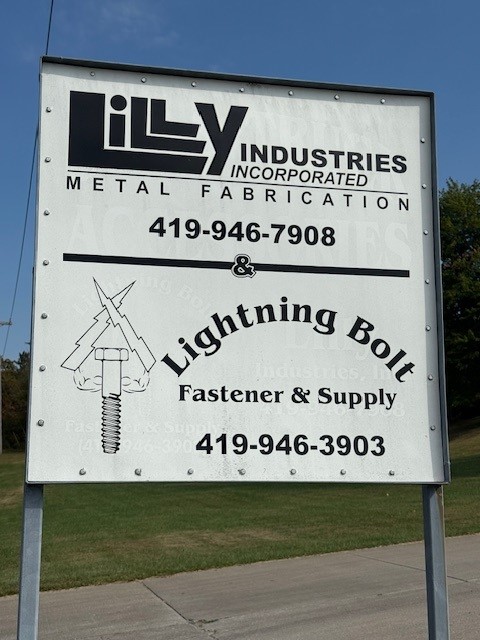
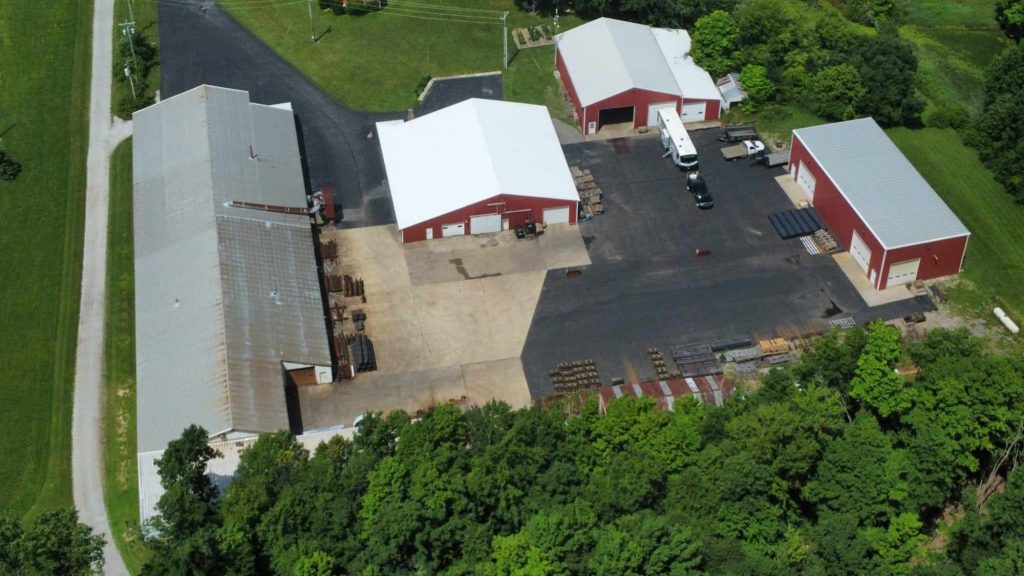
Lilly Industries is a family-owned metal fabrication company located in Mount Gilead. They share that as a community-focused company, they are dedicated to supporting their customers’ success while investing in the people and future of Morrow County.
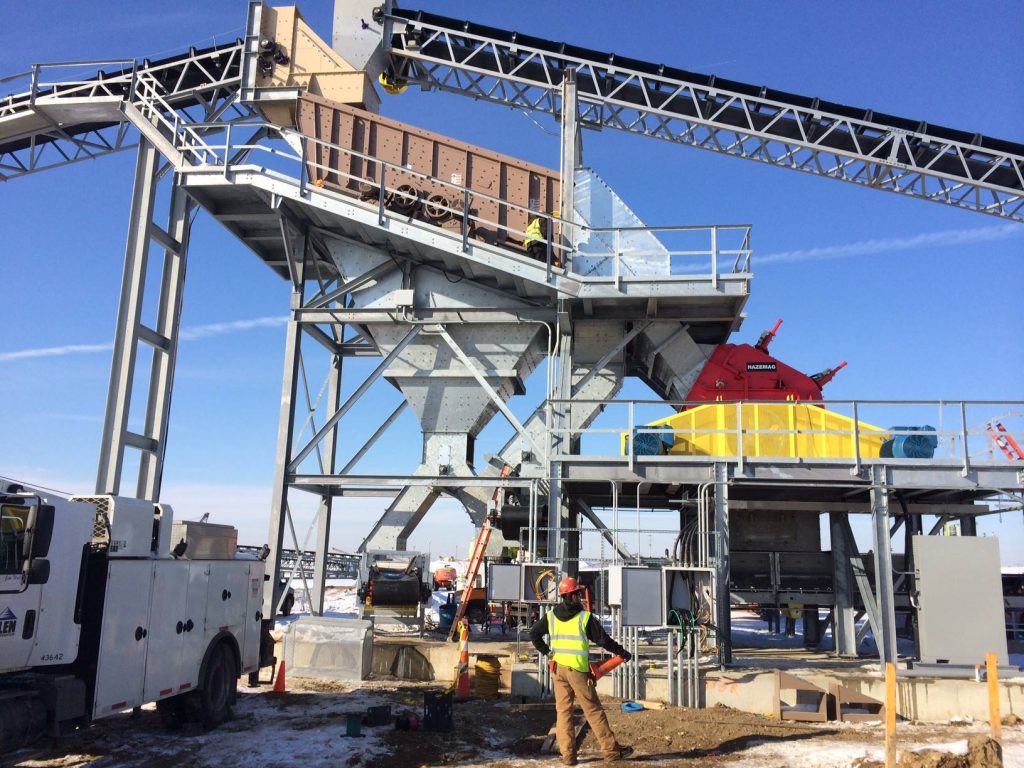
Lilly Industries was established in 1971. Their mission is to deliver quality metal fabrication based on the specific needs of their customers. They provide fabricated products to a wide range of industries throughout Ohio and the United States.
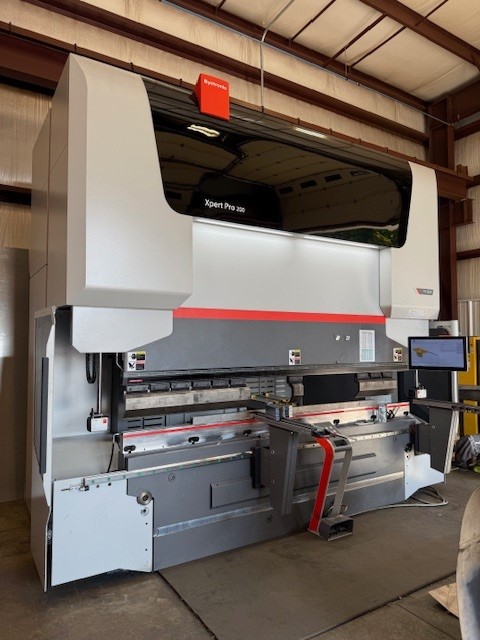
Their facilities include a 20,000+ square foot fabrication shop and a 3,000 square foot assembly building. They offer AWS certified welders, laser cutting, plasma cutting, state-of-the-art brake presses, beam drilling, and more. In addition, they also house their own fasteners and industrial supplies company: Lightning Bolt Fasteners.
Lilly Industries shares that a metal fabricator is only as good as the equipment they use, so they invest their resources to ensure they have up-to-date technology and equipment to compete in today’s industry.
As a longstanding part of the Mount Gilead community, Lilly Industries has created jobs and provided long-term careers for over 50 years. They place a high value on helping their community thrive and helping strengthen the local economy through partnerships with other local businesses.
“We take pride in sourcing within our region whenever possible,” shared Niki Lilly, Office Manager at Lilly Industries. “We actively support our schools, youth programs and community events. We are dedicated to helping our community grow and thrive, and we are proud to call Morrow County home.”
To learn more about Lilly Industries, check out their website and Facebook page below: